If you want to understand the modern soul of American and Australian sports, do not look to the football pitch. Look to a swimming pool in Sydney, 26 years ago.
It was the 2000 Olympics, and the American men’s 4x100m freestyle relay team had spent weeks bragging that they would smash the Australians “like guitars”. Instead, an electric, home-crowd-fuelled Aussie quartet touched the wall first, broke the world record, and stood on the blocks mock-strumming furious air guitars right back at their shell-shocked rivals.
For decades, this has been the operational reality of the USA-Australia sporting relationship. An elite, hyper-athletic feud masked as a sibling rivalry. They have traded body blows on Olympic athletics tracks, fought on basketball courts, and stared each other down from opposite ends of tennis nets. Two nations built on the identical, uncompromising belief that they are, athletically and culturally, the ultimate sporting powerhouse.
Yet for the longest time, football was exempted from this cultural war. It was a secondary sport in both lands. That is now a thing of the past.
ALSO READ | Mexican prisons are reviving cricket — empire brought it, revolution killed it
When the US and Australia step onto the field at Seattle Stadium on Friday, Group D supremacy will be on the line. The cross-sport animosity is finally spilling onto the football pitch, carrying with it lingering dressing-room anger, geopolitical friction, and a heavy dose of media disrespect.
The tension in Seattle isn’t only generated by the athletes. It mirrors an increasingly complex diplomatic relationship at the highest levels of government. The traditional mateship between Washington and Canberra has faced unprecedented public strain this year. Australian Prime Minister Anthony Albanese has repeatedly had to establish firm boundaries with US President Donald Trump over the prosecution of geopolitical conflicts.
The most striking flashpoint involved football itself. When the Iranian women’s team sought political asylum during the Asian Cup in Australia, Trump took to social media to pressure the Australian government aggressively, declaring that the US would step in if Canberra failed to act. Albanese bypassed the bluster, executed a rapid protection mission, and drew a rare public concession from Trump: “I just spoke to Prime Minister Anthony Albanese… He’s on it.”
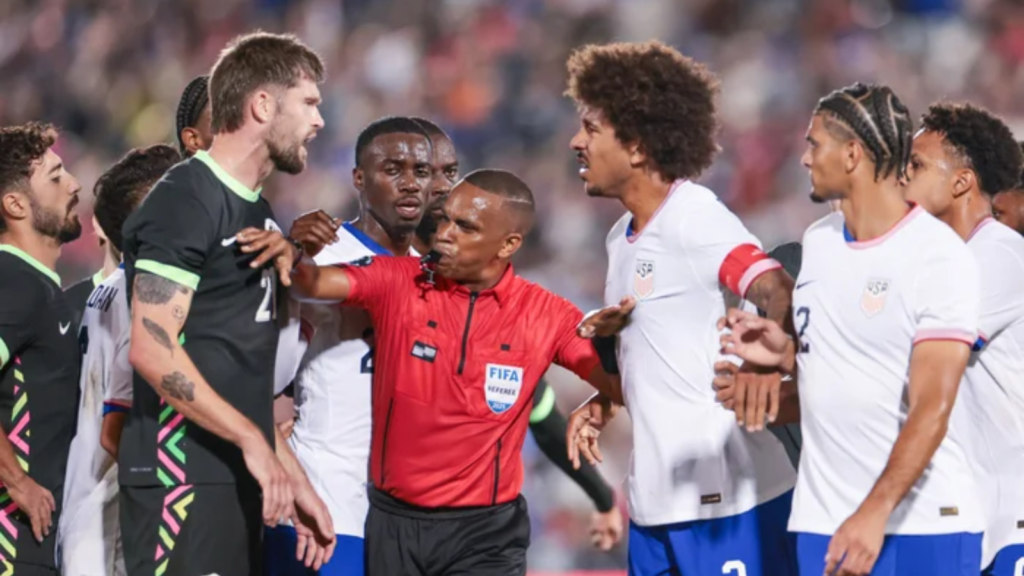
If diplomacy requires a phone call, footballing rivalries require a catalyst on the pitch. For these two teams, that moment arrived on October 14, 2025, in Colorado.
What was supposed to be a standard pre-World Cup preparatory match degenerated fast. The Socceroos, seeking to disrupt the technical superiority of Mauricio Pochettino’s side, deployed an unrelenting physical press. They didn’t just challenge for the ball; they targeted the ankles and psyches of America’s golden generation. By the second half, tactical fouls had become shoving matches. The flashpoint came near the touchline, where American defender Chris Richards had to be physically restrained from charging the Australian bench. Sports Illustrated later reported that Richards had openly threatened Australian players following what the US camp viewed as a series of dangerously cynical challenges.
At halftime, a usually calm Pochettino reportedly delivered a blistering, expletive-laden speech demanding his players stop being kicked around the park.